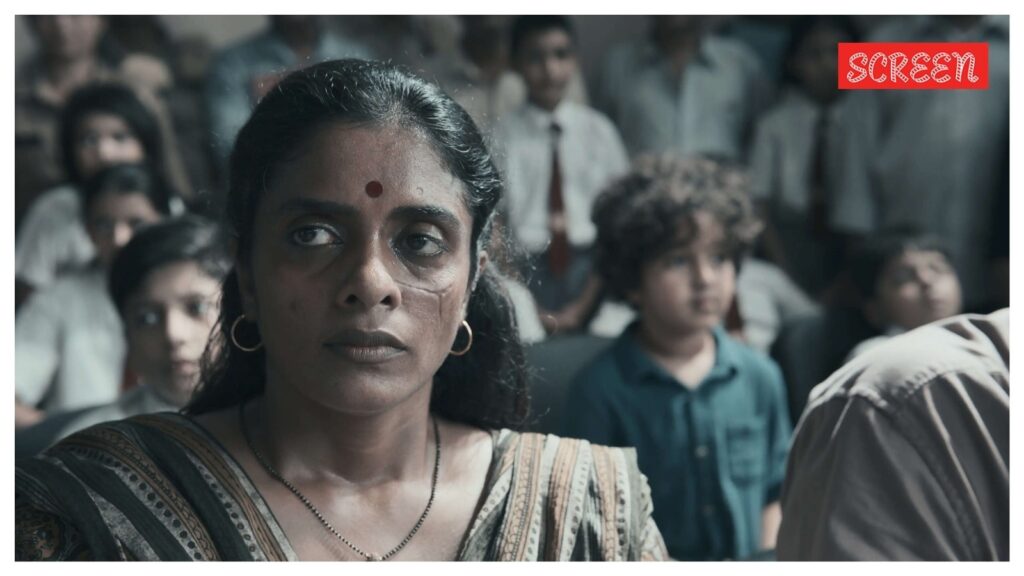
After her global breakthrough with Payal Kapadia’s All We Imagine As Light a couple of years ago, Kani Kusruti has now made inroads into Hindi cinema with Anubhav Sinha’s courtroom drama Assi. She plays Parima, a rape survivor in New Delhi seeking justice against her perpetrators in a local court, being represented by a driven lawyer Raavi (Taapsee Pannu). In an exclusive interview with SCREEN, the actor discusses her language constraint, change in women’s safety on Malayalam film sets, and her take on vigilante/saviour/revenge sagas.
You’ve previously said you’ve been approached inappropriately at workplace. Have the film sets become safer after the formation of the WCC (Women in Cinema Collective) in Kerala?

I’m seeing a change in Kerala at least. Fifteen years ago, if I’d go to a Malayalam film set, you’d mostly have other female actors as the only other women. Compared to Kerala, whenever I come to Mumbai, there are more women present on set. That already changes the workplace nature. In Kerala, you’d see barely one female assistant director, that too only much recently. Earlier, they wouldn’t get paid or get facilities like washrooms on set. But nowadays, because people have been talking out loud and of how WCC emerged, most sets have an internal committee which women can go and talk to. So, there are more women now even on the creative side. People think before doing anything.
Do you feel that’s actual change, or is it only out of fear?
Somewhere, it’s coming out of fear, which is not ideal. It makes one feel that you’re hiding. You can have uncontrollable thoughts about something, but you should learn to think and behave. Some things are genetic, and you may not have control over them. But you have control over how you want to act on something. Like I may love sugar (but do I have to indulge every time?). So, there’s some change in Kerala, which I’m very happy about. Also, the younger generation is different. They may have different issues, which will emerge and we’ll see how to deal with them, but yes there’s change.
How difficult were the rape sequences in Assi to shoot for you?
It’d be as difficult for me as my co-actors, who have to do an act they otherwise wouldn’t do. They were also struggling. Maybe I was struggling less. I have a clinical approach. I’m very comfortable with my body. I’m from theatre. When I read a news that something’s happened, that really terrifies me. When it’s fiction, I always approach it like that. It doesn’t affect me as much as it would in case of a news, where it actually happened. That terrifies me every day.
Story continues below this ad
How would you describe your character’s equation with Taapsee’s in the film? It’s not saviour syndrome, right?
When I did it, I didn’t realize it, honestly. When I watched it, I really liked how the equation is coming through. There’s always a saviour otherwise. It didn’t feel like that here. A lot of women go through this differently. It often comes across like they need help. Everybody needs help, but it’s not inclusive of all the things women go through. In this film, all female characters — including Revathy ma’am’s character (the judge) and even Taapsee’s assistant — have different perspectives from their own journey, which is a very good interpretation.
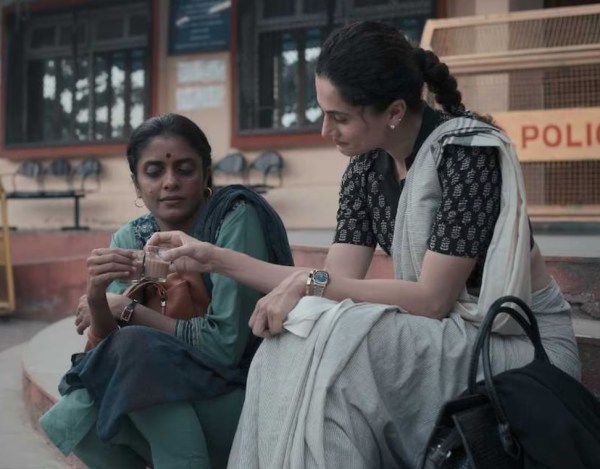 Kani Kusruti and Taapsee Pannu in Assi.
Assi also deals with a track on vigilante justice. Do you think it’s a school of thought that’s also been perpetuated by Indian film?
While I think it’s very much patriarchy, sometimes the emotions and responses we carry in present day have existed way into the past. You need a hero for the community to survive. You feel protected that your progeny would go on. We’ve come a long way. We’ve had civilization and a Constitution. We may no longer need to go to war and seek revenge. We can just sit and talk it out now. We’ve come a long way as a species, but a lot of emotions might have existed in us genetically for our survival. But some are probably vestigial emotions, like we have appendix as a vestigial organ. I wonder is that why I see hypocrisy in how people who preach something behave otherwise when the same thing happens to them, after all that education and exposure. Sometimes, it’s an impulsive behaviour. It’s not if somebody thought and behaved that way. I want to behave nicely, but sometimes I think I didn’t.
Story continues below this ad
Is there a vigilante film you’ve seen that you’ve enjoyed?
There’s this Malayalam film, Maheshinte Prathikaaram (2016). The title is about the revenge of the hero. We were so prejudiced, but it was ironically put. They were actually making fun of it. At the end, the heroine says, “Yes, now he’ll have to go take revenge because he’s a man.” (Laughs) I love the film for that. Maybe we have some innate feelings, but can we just make fun of them and not act on them right now? Because they’re vestige and not needed. We don’t need to have saviour revenge films anymore because we know why they were there in the first place. Can’t we expand our minds to have something more interesting, complex, and nuanced?
Why do you think you’re not getting enough Hindi films now?
Story continues below this ad
Because I don’t speak Hindi. I won’t be able to do all the parts that come to me. I tell them, “Please don’t cast me.” It has to be something like Assi because Anubhav very nicely made my character to be from Kerala. Otherwise he wanted it to be from some other part of North India, Delhi probably. I told him I can’t even learn the lines. I’d take so much time to even understand them. I don’t think I can learn Hindi that fast. Also, culture and so many other things. I’m a true Malayali in every aspect. I still think in Malayalam. I’ve to constantly translate when I speak in English.