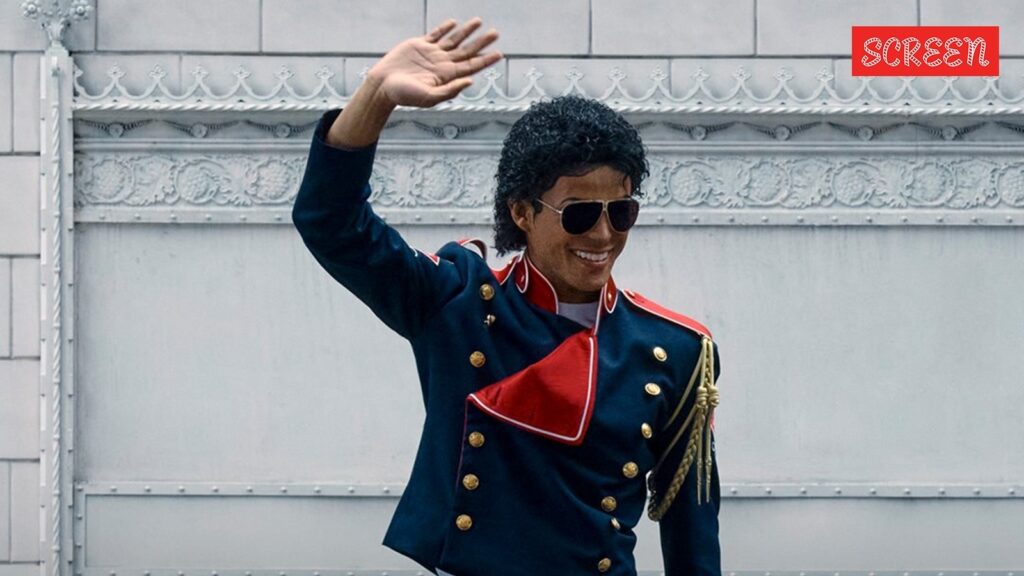
The upcoming Hollywood film Michael, based on the life of Michael Jackson, has been in the making for a couple of years now, as principal photography wrapped in May 2024. But, in the months after this, the film’s third act was entirely written, and now, the film does not mention any details about the child molestation accusations that Michael was subjected to for the last decade of his career. This, the production claims, was an oversight by the attorneys of the Jackson estate.
What followed was one of the more expensive course corrections in recent Hollywood memory: a complete rebuild of the film’s final act, 22 days of additional photography, a bill of up to $15 million, and a release date that moved not once but twice. Michael, directed by Antoine Fuqua and starring Michael Jackson’s nephew Jaafar Jackson, opens in the United States on April 24, 2026. The story of how it got there is almost as complicated as its subject.

The legal clause that changed everything
The original version of Michael was built around one of the defining crises of Jackson’s career. According to Variety, the film was supposed to open in medias res, with a scene of Jackson staring at his reflection while police car lights flashed behind him. The scene was set in 1993 when he was first accused of child molestation. The third act was largely devoted to the fallout from those allegations, including a sequence depicting investigators arriving at Neverland Ranch to search for evidence. None of that made it into the finished film.

Attorneys for the Jackson estate, which served as a producer on the film, discovered a clause in a settlement with accuser Jordan Chandler that explicitly barred his depiction or mention in any movie. The discovery came late, and it meant that everything built around that narrative had to go.
The 1993 case involved Evan Chandler, who alleged that Jackson had sexually abused his then-13-year-old son Jordan. An initial investigation found no evidence against Jackson, and the family reached a financial settlement in early 1994. Jackson’s legal team consistently maintained the settlement was not an admission of guilt. What nobody had apparently checked closely enough was what that settlement actually prohibited.
Reshoot of $15 million
The cast reassembled for 22 days of additional photography in June 2025, with the reshoot bill coming to between $10 and $15 million. According to the same report, that cost was covered entirely by the Jackson estate, given that its own attorneys had failed to flag the clause. As a result, the estate now holds an equity stake in the film, which is possibly why many are seeing this as an image whitewashing exercise for the late singer.
Story continues below this ad
Lionsgate had greenlit the original production at a budget of $155 million. The reshoot costs landed on top of that. The additional photography took place in Los Angeles rather than the original primary location of Santa Barbara, and crucially did not qualify for state tax rebates, which drove the additional cost higher. The process was also set back when screenwriter John Logan’s home was damaged in the Palisades fire. The film had originally been set for April 18, 2025, then moved to October 3, 2025, before settling on its current April 2026 date.
What the film looks like now
According to a source who spoke to the publication, Michael now ends at a very different point in Jackson’s life. The final scene is set during his “Bad” tour, with Jackson preparing to take the stage. The film leans heavily into his music and performances, and the dramatic tension in the new version centres on his relationship with his father, Joe Jackson, who resisted his son’s solo ambitions at the expense of the Jackson 5. The film also covers Jackson’s recovery from severe scalp burns sustained during a pyrotechnics accident on the set of a 1984 Pepsi commercial.
Colman Domingo plays Joe Jackson. Nia Long plays Katherine Jackson. Miles Teller plays attorney John Branca. Janet Jackson does not appear as a character in the film. Prince Jackson, Michael’s son, served as executive producer and was a regular presence on set throughout production.
The backlash that preceded all of this
Even before the reshoot story became public, the film had been drawing fire. The most pointed criticism came from Dan Reed, the filmmaker behind the 2019 HBO documentary Leaving Neverland, which featured accounts from Wade Robson and James Safechuck, two men who allege Jackson sexually abused them as children. After reading an early draft of the biopic’s script, Reed called it “a complete whitewash,” telling The Times of London: “It’s an out-and-out attempt to completely rewrite the allegations and dismiss them out of hand, and contains complete lies. You never even see him alone with any boys, when it is a matter of fact that he shared his bed with small children for many years.”
Story continues below this ad
Lionsgate pushed back, promising in press statements that the film would offer “a riveting and honest portrayal of the brilliant yet complicated man” covering both his “undeniable creative genius” and his “human side and personal struggles.” Director Antoine Fuqua told Entertainment Weekly that his goal was to “tell the facts as we know it, about the artist, about the man, about the human being.”
Jackson always maintained his innocence throughout his lifetime and was acquitted on child molestation charges in 2005.
What the numbers say
Despite the production turbulence, the commercial signals are strong. The teaser trailer, released by Lionsgate in November 2025, clocked 116.2 million views in its first 24 hours, breaking the previous record held by Taylor Swift: The Eras Tour at 96.1 million views.
Early box office tracking, as reported by Variety, points to an opening weekend north of $55 million domestically, which would clear the $51 million that Bohemian Rhapsody opened to in 2018. That film went on to earn $910 million worldwide. Straight comparisons are difficult because Bohemian Rhapsody came out before the pandemic, and more recent musical biopics like A Complete Unknown have operated on a smaller scale.
Story continues below this ad
The sequel question
Producer Graham King has already begun conversations with studios about follow-up films. According to Variety, he has indicated the next instalment would focus on Jackson’s later albums, including Dangerous from 1991 and Invincible from 2001, the construction of Neverland Ranch, and what he described as Jackson’s “love of animals.”
What those sequels would do with the legal battles and abuse allegations that defined Jackson’s final years remains an open question.
Michael opens in US cinemas on April 24.
DISCLAIMER: This article contains factual reporting on the production and legal history of a public figure’s biopic. The views and criticisms mentioned are part of the public record and do not constitute a recommendation or a definitive judgment by this publication.