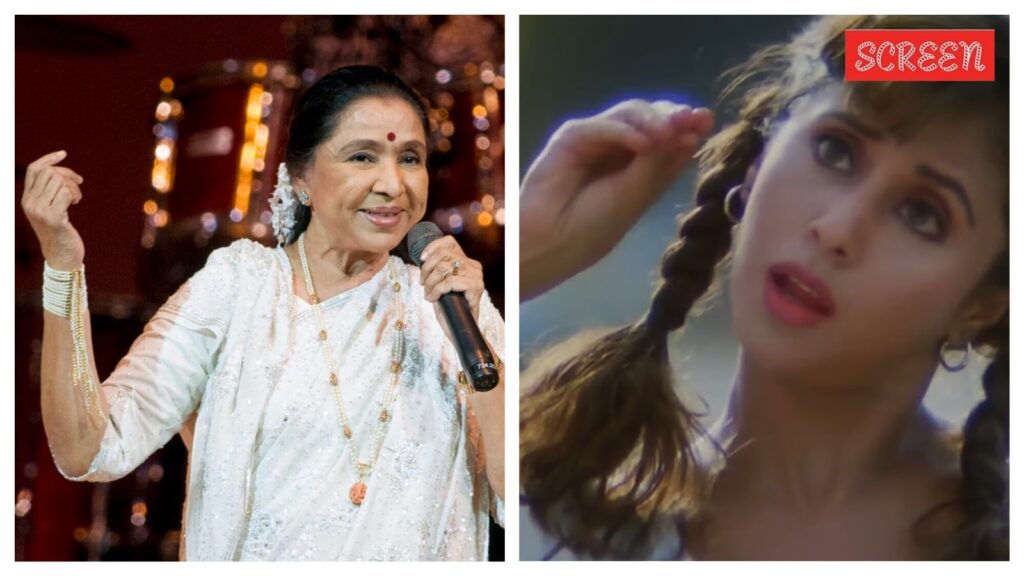
At the start of Rangeela, AR Rahman announced his arrival in Hindi cinema with the pulsating opening of the title track, “Rangeela Re.” But he was sounding the bugle not just for himself, but also for choreographer Ahmed Khan, as Hindi film audiences had never seen that kind of street-style choreography on screen before. Nor had they experienced the dreamy visual language of a Ram Gopal Varma film. Urmila Matondkar, once the bright child actor from Shekhar Kapur’s Masoom (1983), burst onto the screen here, announcing her transition into a confident leading lady.

There was only one voice at the start of Rangeela — strikingly familiar yet rebelliously raw — that served as a reassuring nod to a disoriented audience transported into a whole new world. “Yaayi re, yaayi re, zorr laga ke nache re,” sang the then-62-year-old Asha Bhosle, who breathed her last today. She invited the audience to embrace the new, just like she had done in each of the five decades she had made a mark in since her debut in 1943.
“‘Rangeela Re’ wasn’t just a song. It was a thunderclap that shook Bollywood,” Ram Gopal Varma tells SCREEN in an exclusive interview. Of course, it was AR Rahman who whipped up the aurally unprecedented composition, but it was Asha Bholse’s “youthful fire” that lent an “immortal soul” to the title track. “Asha ji’s playful sensuality, mischievous energy, and unimaginable vocal range created pure cinematic magic that redefined the rebellious spirit of that film’s music,” adds Varma.
While the lead actor — Aamir Khan — was also a newcomer then, it was the likes of Jackie Shroff and Asha Bhosle who stepped in to give their blessings to Rangeela, a film that dared to challenge the status quo and usher in a new era of movie magic. With an experience of 50 years backing her, Asha could have easily called the shots on set, but RGV recalls her walking into the recording studio “with the poise of a queen, yet carrying the wide-eyed childlike curiosity of a newcomer hungry to experiment with a new-age music director like Rahman.”
Ram Gopal Varma further recalls that it just took Asha Bhosle one take to adjust a phrasing before the magic “flowed like a torrential storm.” Hailing her as his “all-time favourite singer,” Varma said Bhosle as “the heartbeat of an entire era” and her voice “flowing like a river through generations, bridging classical roots with modern beats across multiple languages and diverse emotions.” It took RGV and Rahman to untap a sensual volcano that had been lying dormant inside the singer for years.
She had consciously carved out an image distinct from her elder sister and legendary singer Lata Mangeshkar, by not limiting her vocal prowess and creative choices to melodies. She also became the voice of the OG item girl, Helen, belting out one cabaret after another. With “Dum Maaro Dum” in Dev Anand’s Hare Rama Hare Krishna, she catapulted Zeenat Aman into a punk icon and the gold standard of stoners for generations to come.
Story continues below this ad
Asha Bhosle teamed up with the equally zealous Gulzar and her husband-cum-partner-in-crime RD Burman for a rather suggestive Christmas carol — “Raat Christmas Ki Thi” from the 1987 album Dil Padosi Hai, where she blamed the free will of Jesus Christ (“marzi Jesus ki thi“) for her sexual adventures. Mind you, that song came out in the same year as the trio’s National Award-winning melody, “Mera Kuchh Saaman” from Ijaazat. Her rich range, which continued with Rahman, always screamed this dichotomy — Yes, I can plunge into the depths of a “Radha Kaise Na Jale”, “Rang De”, and “Kahin Aag Lage Lag Jaye”, but also infuse madcap energy into the more offbeat tracks like “Chori Pe Chori” from Saathiya.
“From sensuality to soul-stirring depth, she captured the full spectrum of the human feeling like no one else ever,” sumps up Ram Gopal Varma, who then explored the limitless yet untapped potential of Asha Bhosle through the more ebullient songs like “O Bhavre” with Yesudas in Daud (1997) and “Sapne Mein Milti Hai” from Satya (1998). He even turned the romantic image of Bhosle on its head, making the singer of enduring romantic ballads like “Chura Liya Hai Tumne Jo Dil Ko” and “Aao Na Gale Lagao Na” diss romance with the anti-love anthem “Kambhakht Ishq” in his 2001 production Pyaar Tune Kya Kiya.
RGV and Bhosle’s most audacious collaboration came a year later — “Khallas”, a cautionary song composed by Sandeep Chowta for the 2002 gangster movie Company. “Coincidentally, today marks the 24th anniversary of ‘Khallas’ from my film Company, shot on the fiery Isha Koppikar. That ultra seductive, high-octane number, with its thumping rhythm and Asha ji’s commanding voice, became a quintessential item song that still pulsates with undefined energy,” says Varma.
Story continues below this ad
Besides Ram Gopal Varma and AR Rahman, only Radhika Sapru and Vinay Shukla capitalized on Asha Bhosle’s telling sensuality with songs like “Raat Shabnami” from Leslie Lewis’ 1997 album Janam Samjha Karo and “Lucky Lips” from their 2005 romantic movie Lucky: No Time For Love, composed by Adnan Sami. Bhosle’s last couple of memorable film songs — “Prem Mein Tohre” from Begum Jaan (2017) and “Aasmaa” from Saand Ki Aankh (2019) may be softer melodies enriched by her lived-in octogenarian voice. But it’s almost a certainty that even at 92, Asha Bhosle still had the verve and vivacity to pull off another sensuous number like “Sharara”. Only if the society and the industry she inhabited could catch up with her.