
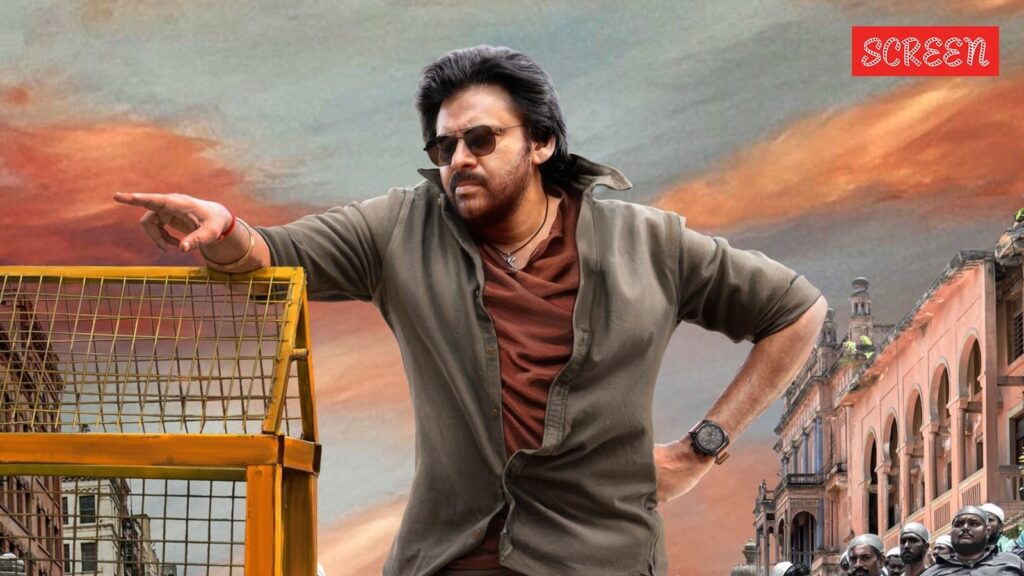
The reunion of Pawan Kalyan and director Harish Shankar was always going to carry immense expectations. Their first film together, Gabbar Singh (2012), was a full-blown commercial hit that appealed to both audiences and critics. After the resounding success of Gabbar Singh, Pawan Kalyan and Harish Shankar announced their reunion in 2020. However, due to multiple factors, the film, Ustaad Bhagat Singh, stayed in various stages of production before finally arriving in theatres on Thursday. That is a long gap for any combination to sustain its momentum, and it shows.
Ustaad Bhagat Singh is about a teacher (K.S. Ravikumar, who works for the welfare of children in the tribal areas of Andhra Pradesh, encounters a brave tribal boy. The teacher names the boy “Ustaad Bhagat Singh” and shapes him into an educated young man with a strong social conscience. Bhagat eventually becomes a police officer and fights against evil forces, while his teacher rises to become the Chief Minister of the state. Along the way, there is romance with a Radio Jockey named Geetha (Sreeleela) and a corrupt politician (R. Parthiban) as the primary antagonist.

It is a familiar Telugu mass entertainer setup, and Harish Shankar does not shy away from that at all. However, it falters so badly that nobody can predict why it didn’t work out.
If you are watching this film, you are watching it for Pawan Kalyan, and the film knows that well. His look and styling in Ustaad Bhagat Singh is by far one of his best in recent times. He dances well, leverages his comedy timing, and as usual plays to the galleries in action sequences.
While Ustaad Bhagat Singh tries to be another Gabbar Singh, and fails miserably, the star shows that when he is in flow, he can plaster over the flaws. Every few minutes, the film stops to remind you how great Bhagat Singh is. Other characters exist largely to react to him, applaud him, or be rescued by him.
As a crooked politician, Parthiban delivers a rather terrible performance — dare we say one of his weakest characters. K.S. Ravikumar, in the role of the teacher-turned-chief minister, delivers a mature performance, different from the comedy-heavy roles he typically takes on.
Story continues below this ad
This is where the film genuinely disappoints. Devi Sri Prasad has scored chartbuster albums for Pawan Kalyan in the past, including Jalsa, Gabbar Singh, Attarintiki Daredi, and Sardaar Gabbar Singh. Unfortunately, for Ustaad Bhagat Singh album is mediocre. Apart from the song “Dekhlenge Saala,” other songs in the film are below par. Thaman S’ background score is pretty standard and fails to lift the film. Given that he was onboarded just a few days before release, his score appears rushed.
The real problem is not that the director looks at the past for inspiration; it’s that he never moved on from it. The film functions almost like a spiritual sequel to Gabbar Singh, but in 2026, those templates feel outdated. The narrative leans heavily on predictable beats, old songs from Pawan Kalyan’s discography, the villain does not get enough meat to be memorable, and the second half drags.
Beyond the writing, the film has visible technical issues that compound the viewing experience. There are continuity gaps between scenes that are noticeable enough to pull you out of the moment. The camera work is another problem. The scenes are constructed in an outdated style; the presentation screams datedness. Rather than drawing you deeper into the scene, the camerawork repeatedly announces itself and breaks the immersion. Good cinematography is invisible; here, it frequently gets in the way.
Story continues below this ad
Pawan Kalyan’s unmatched screen presence and impressive dialogue delivery make Ustaad Bhagat Singh tolerable, but only for his fans. It is not unwatchable, but it is not the kind of film that holds up once the star power fades from the frame. The ‘god-ification’ is not earned through the story; it is simply assumed and constantly reinforced. For non-fans sitting in the theatre, this gets exhausting well before the interval.
What makes it worse is that the film reaches for genuinely sensitive topics like mental health, religious harmony, and political integrity, drops them into scenes as talking points for the lead character, and then moves on without doing anything meaningful with them. These are not themes the film explores; they are props used to make the hero sound wise. It leaves a bad taste precisely because the subjects deserve more than a punchy dialogue and a camera push-in on Pawan Kalyan’s face.
Ustaad Bhagat Singh is the kind of film that fans will find moments to cheer in, but general audiences are likely to walk out feeling they have seen this before, and done better. The aftertaste of watching the film is rather bad. Pawan Kalyan does what he does best, and there is genuine enjoyment in watching him work. But a good lead performance alone cannot carry two and a half hours when the writing is outdated, the music is underwhelming, and the supporting cast is either underused or underwritten. The result is a film that neither fully satisfies as a mindless entertainer nor earns its more serious ambitions.
Story continues below this ad
If you are a Pawan Kalyan loyalist, there is enough here for you. If you are not, this one tests your patience and yields nothing.