6 min readMumbaiMay 6, 2026 07:14 PM IST
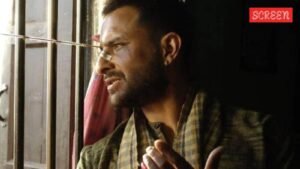
A new god in town, and it is a motorcycle. That is perhaps the simplest way to describe the crackling absurdist indie Dug Dug, debutant director Ritwik Pareek’s self-financed project. The film which first premiered at the Toronto International Film Festival 2021 and is now headed for a theatrical release in India on May 8, backed by industry figures such as Anurag Kashyap, Nikkhil Advani, Vikramaditya Motwane, and Vasan Bala.
Power of manifestation
The story draws inspiration from the Om Banna Temple in Jodhpur, where travellers offer prayers to a motorcycle before setting out on journeys. While the film may be read as a satire on blind faith, another reading situates it as an exploration of manifestation and collective belief. As Pareek explains, in an exclusive chat with SCREEN, this very idea formed the conceptual foundation of the film: “Initially, before I started the film, I wrote a line saying that I want to make a film on manifestation, and how it works. I was reading this book by Itzhak Bentov called Stalking the Wild Pendulum: On the Mechanics of Consciousness. It’s basically a book that explains consciousness from the bare atom to higher-dimensional beings.”

He adds, “In it, he talks about how, for example, when people start focusing on a stone and putting their attention onto it, say, back when we were cavemen, four people might begin thinking that there’s something different about this stone. Then more people start believing the same thing, and eventually something happens because of our attention, belief systems, and collective focus.” While this might suggest a philosophically dense film, Dug Dug operates in an almost opposite register. Its tone remains light-hearted, leaning closer to satire, and this sensibility informs its visual language, (shot by Aditya A Kumar). The frames possess a distinctly graphic, near comic-book quality in their staging; compositions appear highly pictorial, often privileging some sort of symmetry.
Inspiration from 2001: A Space Odyssey
Elaborating through a specific example, a scene in which three policemen are arranged in a manner that is at once stylised and faintly absurd, Pareek observes: “There is something called symmetry and then asymmetry. So the entire frame is very asymmetrical and designed to make your eye move in a particular way. All of that is intentional.
Because it’s designed for a big-screen experience, you have to track eye movement and everything. At the same time, while making it a little funnier, the staging also has to work in that manner. And since it’s a satire, I can play around with the staging to elicit a smile. So that was the idea.”
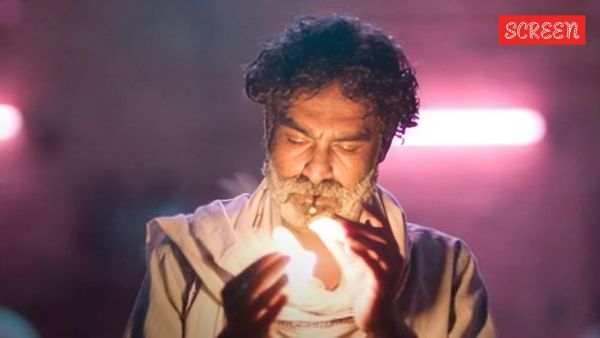 Pareek spoke about the film’s fantastic opening sequence
Also Read | Glory: Pulpy boxing drama suffers from an identity crisis as it keeps gaslighting its own narrative
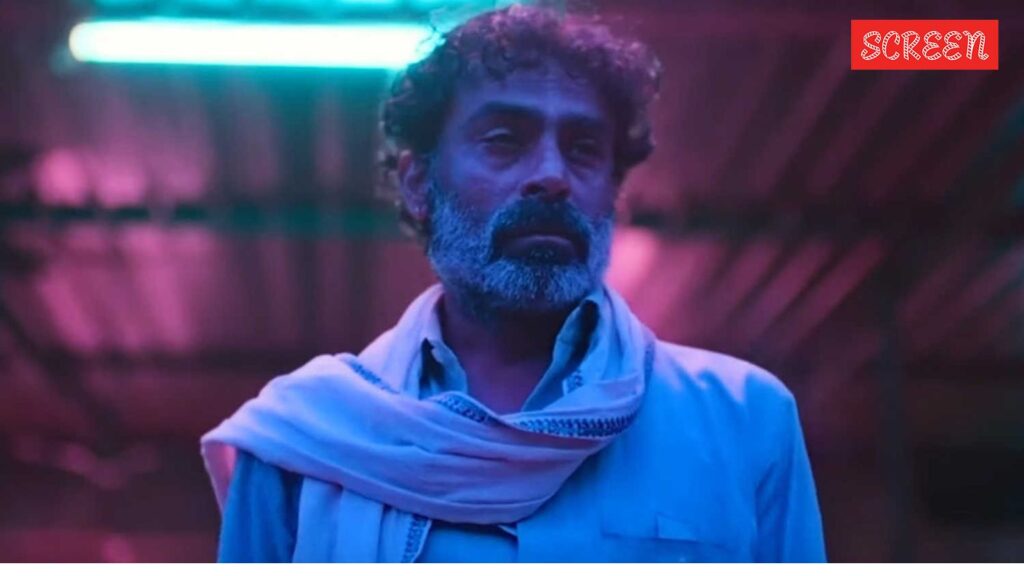
Expanding on the film’s visual design, Pareek reflects in detail on its opening sequence, arguably among the most striking in recent years. The film begins with its rural, inebriated protagonist, Thakur (Altaf Khan), dressed in a dhoti-kurta, setting off on his modest Luna after satisfying his appetite for drink and nicotine at a Rajasthani roadside dhaba. Bathed in pink and blue lighting, the sequence unfolds along an expansive highway, accompanied by stylised background scoring. Drawing a parallel to 2001: A Space Odyssey, Pareek explains: “In 2001: A Space Odyssey, Stanley Kubrick initially cut the Stargate sequence to Pink Floyd’s Echoes, which is like a 22-minute track with four distinct sections. Someone on the internet synced the entire Stargate sequence with Echoes, and it works unbelievably well, it completely transcends the experience. So my thought was: this is the foundation of the film’s visual identity. This is what I want to achieve with the entire film.”
Story continues below this ad
Montages and expansion of time
He further adds: “And what usually happens now is that people cut purely on beats, which makes things predictable. But what about movement? What about feeling? That’s what I wanted to achieve. So every decision we made for the opening sequence was in service of that purpose. And we storyboarded everything, every single shot, down to the bone. The idea was to establish what the rest of the film would look like with all the montages, so we wanted to prepare the audience from the beginning.” Speaking of montages, central to the film’s structure, Pareek notes: “All the montages were written in the script. It all started with the idea that since most of the film is visual, there are very few dialogues, so the question was: how do I show the growth of the temple visually, without explicitly saying it? Also, every time the montage stops, people assume, ‘Okay, now it’s over, now the actual scene begins.’ But then something entirely different happens and it moves in another direction, and again it starts building through more details.”
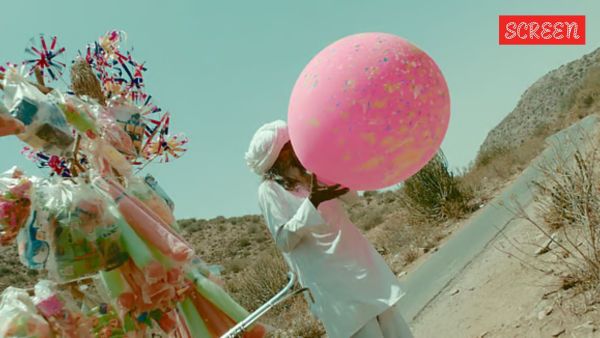 Pareek elaborated on the symbolism behind the recurring visual of a man inflating a balloon throughout the film.
He also refers to a recurring visual motif: a man blowing a balloon that continues to expand throughout the film: “In my mind, that became a kind of metaphor. Since the beginning, the audience keeps expecting the balloon to burst, that the film will end there, or the montage will end there, or something will happen. But I thought, no, that should never happen. The balloon should just keep expanding. Everything that was happening would cut alongside the balloon to show expansion of this lore. That became the central visual idea.” Well, this motif invites another reading aligned with the film’s preoccupation with manifestation, as its endless expansion can be seen as an allegory for how individuals construct and inhabit self-contained realities.

Click here to follow Screen Digital on YouTube and stay updated with the latest from the world of cinema.
© IE Online Media Services Pvt Ltd