

Was the Cannes competition not as exciting as it usually is this year? And were there some films which more than made up for it? Yes, and yes.
In fact, there were two films in this year’s selection which were heads and shoulders above anything I saw in, let’s say, the last five years.
Here’s my Top 5 of the Cannes competition, whose best films spent their time digging for inspiration in the big wars, so apt because the wars never end, and exploring the joints and connective tissues of those who don’t fit into gender binaries, and that’s an on-going battle, too. Love and war, war and love, the stories of our lives.
The Dreamed Adventure
This is literally one of those films where nothing and everything happens all at once. An archeological dig is the site not just to discover buried coins, but a currency that’s current enough to shake this quiet Bulgarian border town, spilling out long-hidden secrets.
It starts with a man looking for an old friend who can help him in his dodgy pursuits. His unlikely partner-in-crime is the protagonist at the centre of the moving parts, and as the film moves along at its life-like pace, it gathers in lived histories of place and people in a way that appears placid. And then suddenly, the script throws a curveball– a car ride at night where the misogynist bones of a group of men gleam, a raucous party where a young girl is rescued from near-disaster– and it becomes, a thought, a memory, a point-of-view, all carrying weight.
Unapologetically itself, The Dreamed Adventure, directed by Valeska Grisebach, is a singular film with particular pleasures, and the more you lean into it, the more you fall under its spell. I began with more than a little impatience; by the end of it, I didn’t want it to end.
5/5
The Black Ball
La Bola Negra (The Black Ball) by the two Javiers, Ambrossi and Calvo, is designed to blow your mind. Multi-layered, multi-faceted, and immensely moving, The Black Ball can be read in as many ways as you’d like to. But the film never takes its eyes off its chief ball: how queer people have been discriminated against down the ages, and how cinema, in all its resistant glory, can become a manifesto and a manifestation, all at once.
Story continues below this ad
Zig-zagging through the Spain of 1932, 1937 and 2017, this second feature by the directors is an astonishingly inventive adaptation of an unfinished work by Frederico Garcia Lorca. A good-looking young man is voted out of an exclusive club simply because of his sexual orientation, the black balls rolling down the staircase an explicit representation of exclusion. A soldier stands guard over an injured rebel, moving from becoming the state’s instrument to a young man finding a deep connection with another young man. And in 2017, a young man finds a densely-written volume, which has been in his recently-deceased grandfather’s custody for decades: the will asks that he travel back to the place where all three strands are found to be intertwined.
Cinematic sleight of hand featuring flashbacks-and-forwards is not new. Playing with time is something film can do better than any other visual art form, but what this film does is to use that device to make something utterly glorious.
5/5
Also Read – The Man I Love movie review: Rami Malek’s Cannes drama is among the best this year
The Man I Love
Rami Malek has such an arresting, mobile face that you almost don’t notice that it is as expressive when he’s not doing much with it. Ira Sachs’s The Man I Love, a film which recreates the Reagen era of the early 80s when another virus was sweeping through the world: HIV-AIDS is an ever-present danger in the life of actor Jimmy George, who lives with his partner in a New York flat, big enough for a piano at the entrance, a bathtub to drown in, and a dining table long enough to arrange vials of the strong antiviral drugs required to keep an infected man alive.
Story continues below this ad
The film opens with Jimmy — if you think Malek was wonderful as Queen in Bohemian Rhapsody, wait for this iteration, in which he dials down the flamboyance, and makes this showiness his own too. In one sequence, Jimmy is the centre of attraction, something he’s clearly used to: this is how a man walks, strutting like the Marlboro Man, and this — creating sinuous figure 8s as he minces across a room — is how a woman does: he is on show, he knows, and he’s doing it not just for the applause while the act is on, but also for his having bested death after a bout of pneumonia. But for how long?
Sachs adds poignance without any underlining. The homophobic parents, the understanding sister and her husband, at hand only some of the time, and the friends-like-family, which includes the flatmate, and a new entrant who falls violently in love with Jimmy. My prediction: Malek is up for many best acting awards this year; an Oscar even.
4/5
Fatherland
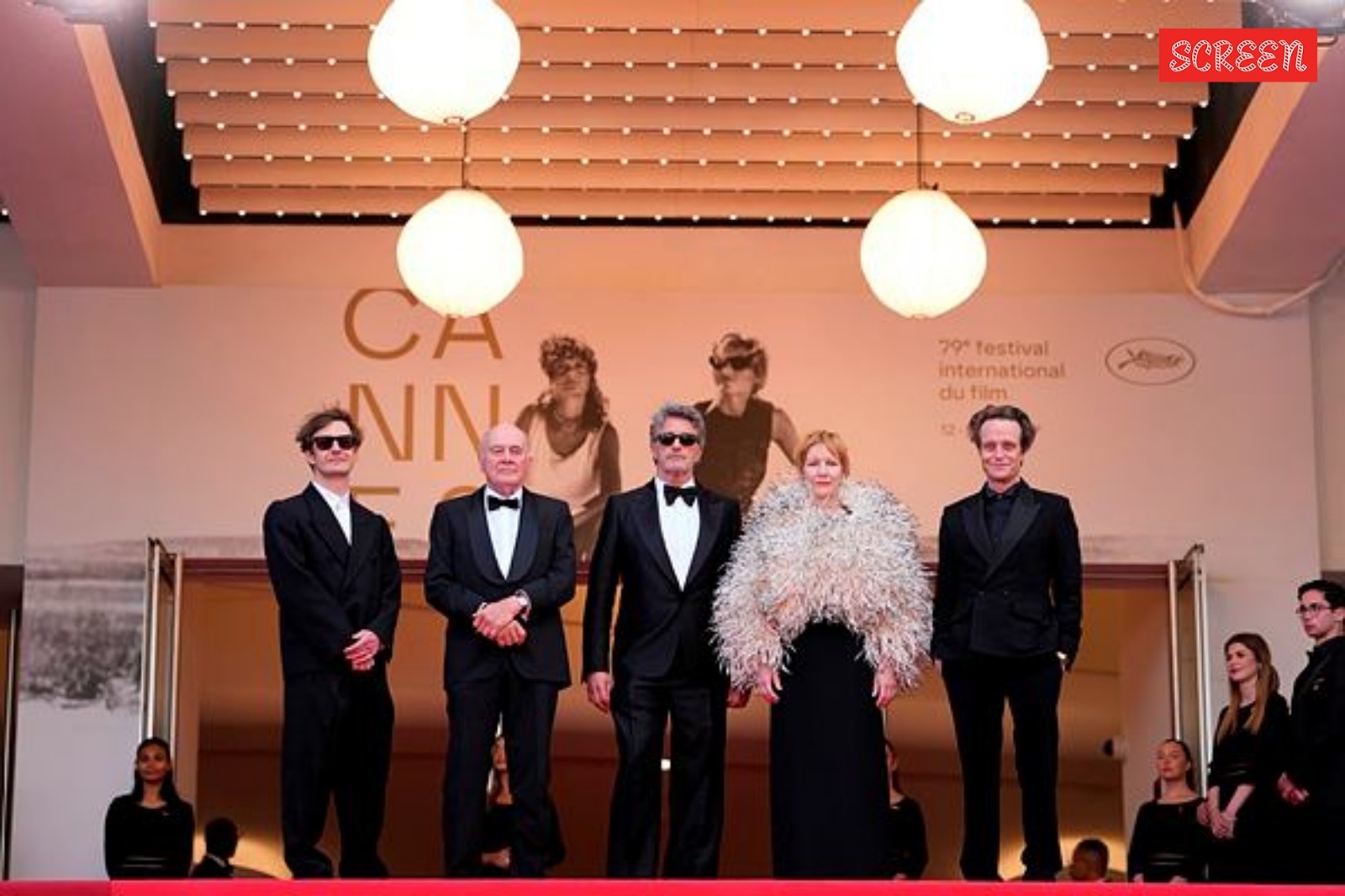 Fatherland team at Cannes 2026.
Pawel Pawlikowski’s most accessible film to date, Fatherland, is a departure from the Polish auteur’s filmography in that it’s the first time it deals with real-life characters, even if his strongly humanist concerns remain the same.
It’s 1949, and Nobel Laureate Thomas Mann, who faced Hitler’s reign and took refuge in the US, is back in Germany. Four years after the second world war, it is a country split into two, one governed by the Americans, and the other by the Russians, struggling to forge an identity while not losing sight of its great legacy of art and culture.
Story continues below this ad
Accompanied by his daughter, played by Sandra Huller, the journey from Frankfurt to Bavaria, signifies a world order that has changed for good. While men and women circle each other cheerily in the Western sector, the border is governed by suspicious soldiers; troops and school-children sing on order, extolling the glories of the fatherland, and even distinguished visitors like Mann are not as free as they think they are.
Crisply told in 97 minutes, shot in the director’s signature black-and-white tones, Fatherland turns its gaze on the big questions of identity and self. Where is home? Where were you born, or where you live now? And where do you really belong?
4/5
Also Read – Minotaur movie review: A brilliant, cold-blooded portrait of a marriage and Russia on the brink
Minotaur
The definition of a minotaur — a mythical creature with the body of a man and the head of a bull — is given a smart twist in this film of the same name, directed by Andrey Zvyagintsev. In this loose adaptation of Claude Chabrol’s 1969 classic An Unfaithful Woman, a mini-oligarch, in a provincial Russian town, deals with professional and personal challenges in different ways: he’s canny when betraying unsuspecting citizens to the authorities, and he’s like a bull in a china shop when he’s dealing with his wife’s betrayal.
Story continues below this ad
Gleb lives with his lovely wife Galina and teenage son in leafy splendour on the town’s outskirts. His comfortable life is shattered when two things happen: the war outside — its 2022, and the Russian invasion of Ukraine has dragged on for six months — is brought home when he discovers that his wife is having an affair.
How the director (Loveless, Leviathan) modernises this classic tale of cuckoldry and adultery, placing it in the heart of a conflict which may not be directly of his making, but is complicit in, is what makes the film so riveting. If you did not steal resources which belong to the people, would there ever be war? If you did not just slay your wife with perfunctoriness, would she ever stray?
4/5