
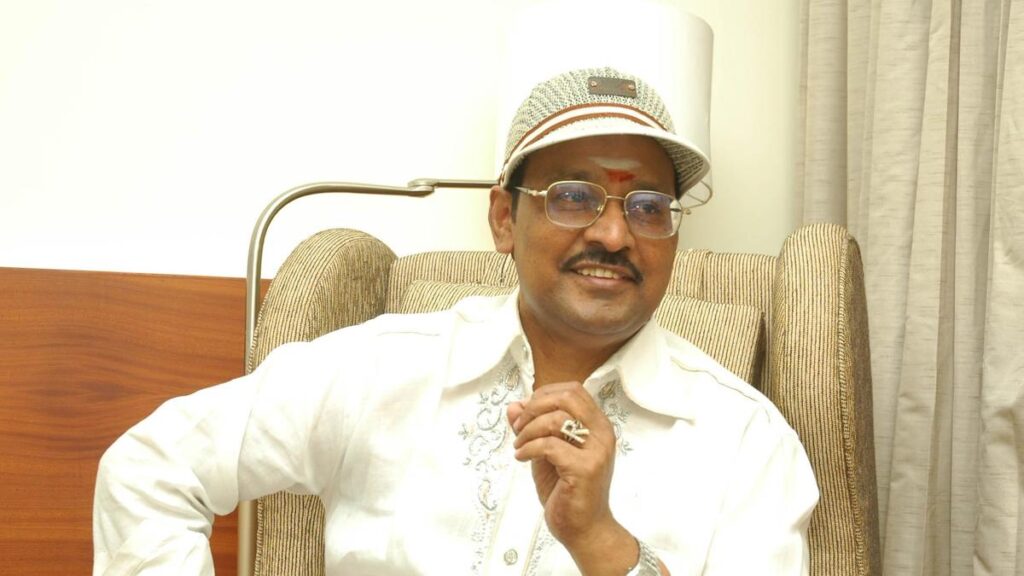
K. Bhagyaraj is one of the very few directors in the Tamil film industry who has been widely acclaimed for his screenwriting. During the late 1970s — a period when stalwarts like K. Balachander and C.V. Sridhar were actively dominating the industry — Bhagyaraj carved out a niche for himself through his engaging and interesting screenplay design.
Also Read : Bhagyaraj passes away | Live updates
Arriving in Chennai with the aspiration of becoming a film director, the first movie Bhagyaraj worked on, was as an assistant director on the film Ezhai Panakkaran. Directed by G. Ramakrishnan, the shooting of this film ground to a halt within just two days. It was after this setback that Bhagyaraj went on to join director Bharathiraja. Having worked on films like 16 Vayathinile and Kizhakke Pogum Rail, he wrote the dialogues for Sigappu Rojakkal. He also made brief on-screen appearances in small roles within the films he worked on.

Although Bhagyaraj was highly skilled in writing screenplays and dialogues, a film featuring him as the lead actor was released even before a film under his own direction could hit the screens.
When Bharathiraja wanted to make the film Puthiya Vaarpugal, he chose Bhagyaraj as the protagonist. Bhagyaraj also penned the dialogues for the movie. Becoming a massive success, this film effectively established Bhagyaraj among the masses.
Realistic storytelling
However, his talent truly shone on the silver screen when his directorial debut, Suvarillatha Chithirangal, was released in 1979. Structurally, it was a deeply melancholic story. Yet, it was the lively and entertaining screenplay of the first half that turned the movie into a noteworthy success.

As Bhagyaraj himself once remarked in an interview, “Our director (Bharathiraja) always preferred to deliver things seriously. But I am someone who likes to convey everything in a lighter vein,” and this film perfectly reflected that philosophy.
The movie Indru Poi Naalai Vaa is a prime example of Bhagyaraj’s signature style. Revolving around the hilarious struggles of three young men trying to charm a young woman in a small town, this film stands as an excellent testament to Bhagyaraj’s storytelling technique and his knack for seamlessly weaving comedy into the narrative. Released in 1981, the film remains a cult classic comedy even 45 years after its release.
Similarly, the movie Antha 7 Naatkal is a pivotal milestone in Bhagyaraj’s career. The story follows a woman who, after being married off to someone else, continues to pine for her first love — prompting her own husband to tell her to return to her lover. However, the film’s climax ultimately remained firmly within traditional values. The screenplay, dialogues, songs, and comedy of this film were all exceptionally well-crafted.

With a string of movies like Oru Kai Osai, Mouna Geethangal, Vidiyum Varai Kaathiru, Thooral Ninnu Pochu, Darling Darling Darling, and Munthanai Mudichu, Bhagyaraj rapidly emerged as one of the most successful directors in the Tamil film industry. Many of the films he directed ran for over 100 days. Notably, Munthanai Mudichu ran for 175 days.
A prime example of Bhagyaraj’s genius was reviving a stalled M.G. Ramachandran (MGR) film after several years by seamlessly weaving it into a brand-new screenplay. The film Anna Nee En Deivam, starring MGR, was originally being directed by C.V. Sridhar. However, because MGR became the Chief Minister, the film was shelved after shooting only about 5,000 feet of reel. Bhagyaraj took those existing scenes, wrote a completely fresh screenplay around them, and filmed it under the title Avasara Police 100. Released after MGR’s demise, the movie enjoyed a successful run at the box office.
Bhagyaraj’s cinematic prowess, however, did not stop at acting, directing, and dialogue writing; he also demonstrated remarkable talent in music composition. Several songs from the movies he scored — such as Idhu Namma Aalu, Aararo Aariraro, and Pownu Pownuthan — became chartbusters at the time. He even lent his voice to a few songs.

Evolving style
The success formula of Bhagyaraj’s early hit movies was fundamentally simple. His films were structured around personal or situational conflicts arising in the lives of ordinary individuals, a screenplay moving toward the resolution of that conflict, good songs, and plenty of situational comedy sprinkled throughout.
However, post-Munthanai Mudichu, critics noted that adult-themed and sexual humor became noticeably prominent in his work. His film Rasukutti, in particular, marked the peak of this trend. Over time, this style evolved to become a definitive hallmark of his cinema.
“As far as Bhagyaraj is concerned, he expanded the boundaries of Tamil cinema in the ‘80s and amplified its entertainment quotient. He achieved immense popularity by blending a lot of music, comedy, and glamour with realistic storytelling. It was because of these elements that his films achieved massive commercial success,” observes Theodore Baskaran, Tamil film historian and author of The Eye of the Serpent.

While Bhagyaraj’s mentor, Bharathiraja, attempted to propagate progressive ideals in some of his films, Bhagyaraj largely refrained from such endeavours. “His films operated firmly within traditional and conservative values. Some critics even considered his movies like Antha 7 Naatkal and Munthanai Mudichu to be somewhat regressive,” says Theodore Baskaran.
Published – June 27, 2026 02:08 pm IST